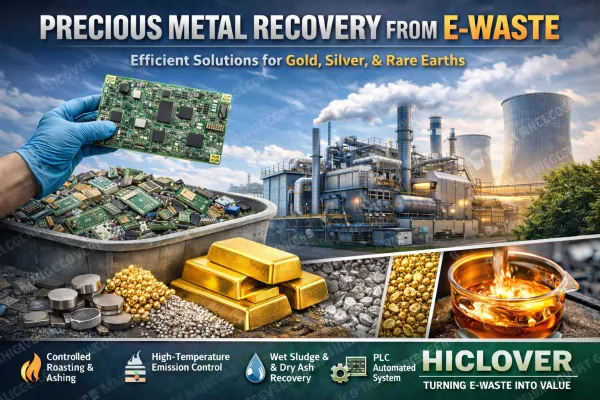
Advanced Approaches to Precious Metal Recovery from E-Waste: Clean Thermal Pre-Treatment for Strategic Resource Recycling
1. Strategic Importance of E-Waste Recycling
Global electronics consumption continues to grow rapidly with the expansion of consumer devices, data centers, electric vehicles, and industrial automation. This surge has intensified demand for gold, silver, platinum-group metals (PGMs), copper, and rare earth elements―all of which are critical to modern technology and supply chains subject to geopolitical and environmental constraints.
Traditional mining operations face increasing challenges, including declining ore grades, regulatory pressures, and high energy costs. As a result, electronic waste recycling has emerged not only as an environmental imperative but also as a strategically important source of secondary metals. Recovering precious and specialty metals from discarded electronics contributes to a circular economy, reducing dependence on virgin mining and aligning with sustainability goals. (维基百科)
2. Core Challenges in Precious Metal Recovery
E-waste is typically composed of a complex mix of metals, plastics, resins, oils, and coatings. Direct leaching or smelting without prior processing can lead to:
-
Incomplete removal of organic binders and plastics
-
Low recovery rates due to contamination
-
High reagent consumption and unstable chemical reactions
-
Emission of oil smoke, volatile organic compounds (VOCs), and toxic gases
-
Loss of valuable metals in uncontrolled ash streams
These challenges make thermal pre-treatment a critical step in preparing e-waste for efficient hydrometallurgical or pyrometallurgical metal extraction.
3. Controlled Thermal Processing for Metal Concentration
Thermal systems designed for precious metal recovery focus on controlled ashing and roasting rather than indiscriminate combustion. The objective is to remove organics while maintaining high metal retention and minimizing emissions. This allows downstream refining processes to operate on more homogenous and higher-grade material.
Key feedstock examples include:
-
Printed circuit board fragments and shredded electronics
-
Precious metalCloaded resins and activated carbon
-
Plastic-coated connectors, cables, and component housings
-
Oily sludges and contaminated process filters
-
Industrial sorting residues and lab-scale recycling by-products
By concentrating metals into a stable ash or intermediate form, recyclers improve both the economics and environmental performance of recovery workflows. (维基百科)
4. Modular A/B/C Process Logic for Enhanced Efficiency
A well-engineered thermal pre-treatment system typically uses a structured process logic to maximize recoverable metal value while controlling environmental impact:
Stage A C Controlled Low-Temperature Roasting / Ashing
This initial stage carefully removes organic content under a managed temperature profile. The result is a dry, metal-rich ash collected on high-temperature trays for centralized recovery. Compared with open burning, controlled roasting minimizes loss of precious metals through oxidation or dispersion.
-
Plastics and organics volatilize in a controlled manner
-
Ash remains rich in metal content
-
Reduced risk of tar formation or uncontrolled combustion
Stage B C High-Temperature Afterburner
Gases and vapors emitted during roasting are routed to a high-temperature afterburner. Complete oxidation of hydrocarbons and VOCs ensures:
-
Elimination of black smoke and foul odors
-
Reduced fouling of ducts and filters
-
Compliance with emission standards
This stage stabilizes gas streams, protecting downstream purification systems.
Optional Stage C C Quench Spray Scrubber
When stricter environmental controls are required, a quench spray scrubber can be added:
-
Rapid cooling and particulate capture
-
Acid gas neutralization and mist elimination
-
Production of wet sludge that can be re-ashed for additional metal recovery
The combined logic of dry ash and wet sludge recovery ensures minimal loss of recoverable metals.
5. Technical and Operational Advantages
Thermal pre-treatment systems built for e-waste recycling and precious metal recovery offer several operational advantages:
-
Dual recovery streams: dry ash and wet-scrubber sludge for maximum material capture
-
PLC recipe control: precise management of thermal profiles, airflow, holding times, and safety interlocks
-
Modular and scalable design: supports containerized or mobile deployment for flexible installation
-
Fuel versatility: options include diesel, natural gas, or LPG
-
Reduced maintenance costs: stable combustion and corrosion control
These benefits make controlled thermal systems suitable for a range of recycling operations, from pilot facilities to large-scale industrial centers.
6. Integration with Circular Economy and ESG Goals
Recovering precious metals and rare earths from e-waste aligns with global efforts to reduce reliance on primary mining and to meet Environmental, Social, and Governance (ESG) criteria. Governments, manufacturers, and recycling enterprises increasingly prioritize domestic processing capacity, strategic material independence, and reduced carbon footprints.
Thermal preprocessing enables cleaner separation before chemical recovery, lowers the environmental risk of downstream processes, and supports broader circular economy ambitions throughout the electronics lifecycle.
7. Application Scenarios for Thermal Pre-Treatment Systems
Thermal solutions for precious metal recovery are suitable for multiple contexts:
-
Commercial e-waste recycling facilities handling mixed electronic streams
-
Precious metal recovery workshops and integrated refining plants
-
Research and development labs focused on material recycling innovation
-
Industrial waste management centers processing contaminated residues
-
Emerging markets developing localized resource recovery infrastructure
8. Conclusion: Turning Waste into Strategic Assets
As demand for gold, silver, platinum, copper, and rare earth elements accelerates amidst supply chain uncertainty, efficient recycling infrastructure is critical. Controlled thermal pre-treatment transforms complex e-waste into concentrated, recoverable material streams, improving both recovery rates and environmental performance.
By combining low-temperature ashing, high-temperature afterburning, and optional wet scrubbing within a modular, PLC-controlled system, advanced thermal solutions provide recyclers with a reliable and scalable path to resource recovery. In doing so, they help turn discarded electronics into a strategic secondary resource, supporting industrial growth, sustainability targets, and long-term material security.
