Medical Waste Incinerator Wet Scrubbing Systems in Ghanaian Hospital Settings
In hospital compounds, waste handling is closely linked to daily infection control. Used syringes, contaminated dressings, pharmaceutical residues, and pathological waste cannot be stored for extended periods without increasing operational risk. In many healthcare facilities across Ghana, incineration remains a realistic and widely adopted treatment method because it allows immediate on-site disposal under controlled thermal conditions.
As hospitals expand and public attention to visible smoke and odor increases―particularly in urban and peri-urban areas―technical interest has grown around the medical waste incinerator wet scrubbing system Ghana. Searches for this topic are often driven by engineering teams and NGOs evaluating how emission control can be strengthened without over-complicating daily operation.
Operational Drivers Behind Wet Scrubbing Selection
Hospital incinerators operate close to patient wards, staff housing, or neighboring communities. Concerns raised by administrators often focus on black smoke during start-up, acidic odors, and overall safety for operators.
Wet scrubbing systems are introduced to address these concerns at the flue-gas stage, rather than altering the core combustion process. In Ghanaian hospitals, where facility scale and budget vary widely, wet scrubbing is typically evaluated as an optional enhancement rather than a default requirement.
Combustion Foundation Before Gas Treatment
Dual-Chamber Incineration Structure
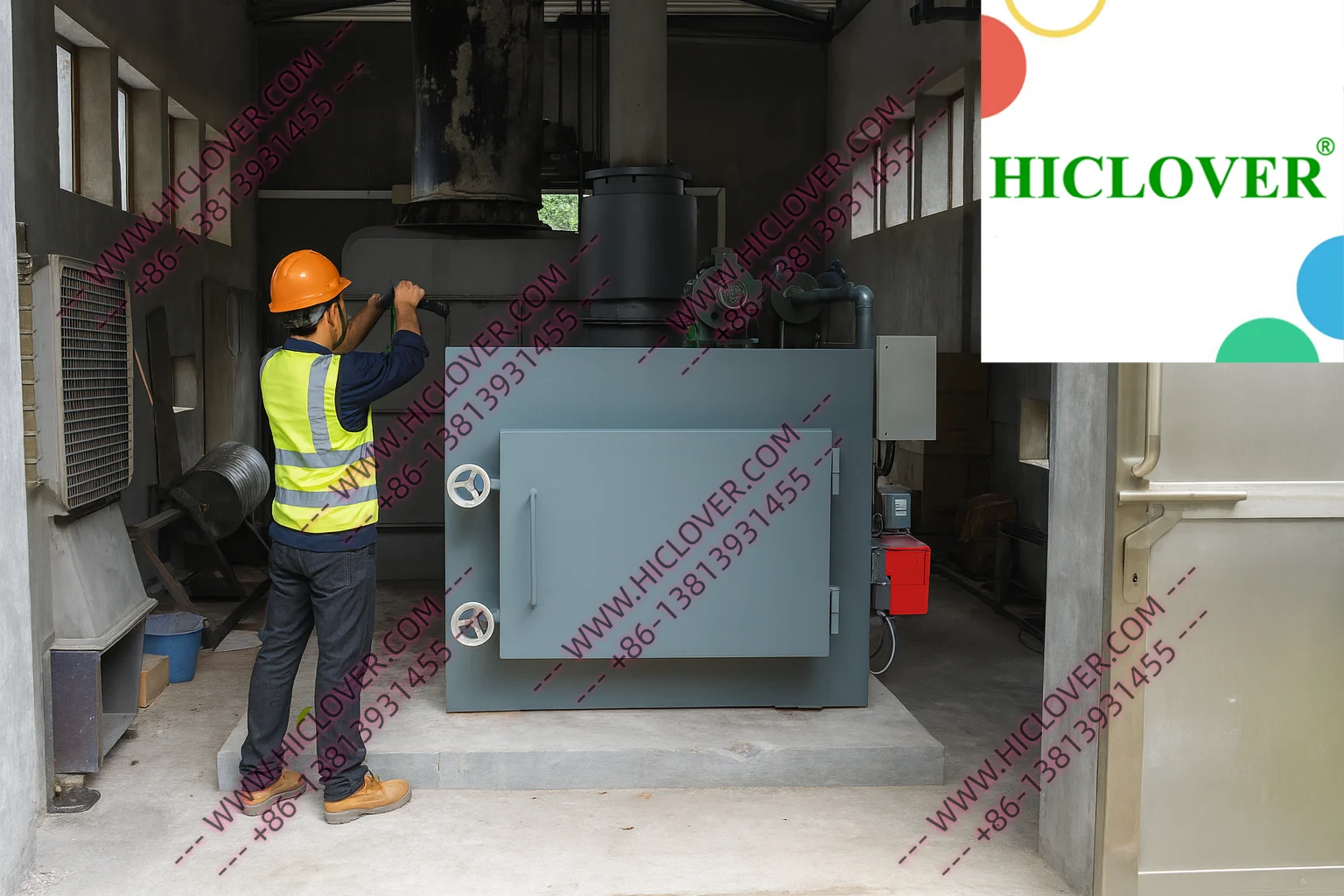
Before any scrubbing system is applied, the combustion foundation remains critical. Hospital incinerators commonly use a dual-chamber layout. The primary chamber handles direct combustion of medical waste at temperatures around 850 °C, ensuring effective destruction of infectious materials.
A secondary chamber is installed downstream and operates at higher temperatures, often approaching 1100 °C. Its role is to re-burn flue gases released from the first stage. This secondary oxidation step reduces incomplete combustion products and stabilizes the exhaust stream before it enters any gas treatment equipment. This configuration is a commonly adopted configuration for hospitals and is designed in line with common healthcare waste management practices.
Wet Scrubbing System Function in Hospital Applications
A medical waste incinerator wet scrubbing system typically combines several functions into a compact assembly. Hot flue gas first passes through a quench section where temperature is rapidly reduced. This protects downstream components and limits thermal stress.
Following quenching, the gas enters a washing zone where contact with scrubbing liquid allows acidic components and fine particulates to be absorbed. Depending on project design, neutralization agents may be used in the liquid circuit. The treated gas is then discharged through an induced draft fan and chimney.
In documentation, wet scrubbers are described as functional modules rather than absolute emission guarantees, allowing project owners to align system complexity with local expectations and maintenance capacity.
Automation and Control Integration
Wet scrubbing systems in hospital incinerators are typically integrated into the same PLC control architecture as the combustion system. The PLC coordinates burner operation, chamber temperature monitoring, and auxiliary equipment such as pumps and fans.
For hospitals with limited technical staff, this integration is important. Automated sequencing ensures that the scrubber operates only when required and follows safe start-up and shutdown logic. This reduces manual intervention and supports consistent daily operation.
Diesel Operation and Infrastructure Constraints
Many hospitals operate under unstable power conditions, especially outside major cities. Diesel-fired incinerators remain practical because combustion stability does not depend on grid reliability. Electrical demand is largely limited to control systems and auxiliaries, which can be supported by existing generators.
Wet scrubbing systems are therefore designed with realistic power and water consumption in mind, recognizing that infrastructure constraints influence long-term operability as much as initial technical design.
Application Across Different Hospital Scales
-
Small hospitals and clinics may rely on dry gas treatment or simplified wet systems due to limited space and staffing.
-
Regional hospitals often evaluate wet scrubbing to address community concerns related to odor and visible emissions.
-
Teaching hospitals typically request more detailed system descriptions to support operator training and internal review.
Across these applications, wet scrubbing is positioned as an adaptable solution rather than a fixed standard.
HICLOVER Manufacturing Perspective
HICLOVER operates as a manufacturing factory supplying standardized medical waste incinerator systems with optional wet scrubbing configurations for export markets. Its approach focuses on repeatable system layouts, documented operating logic, and remote technical coordination rather than project-specific experimentation.
General technical information, configuration options, and system overviews are available through the official website:
https://www.hiclover.com/
This documentation-driven approach supports hospitals, EPC contractors, and NGOs conducting technical evaluations through English-language searches.
Practical Evaluation Considerations
When reviewing a medical waste incinerator wet scrubbing system in Ghana, decision-makers often focus on how emission control integrates with daily hospital routines. Combustion stability, automation level, maintenance effort, and operator safety tend to weigh more heavily than theoretical performance claims.
For healthcare facilities balancing infection control, infrastructure limitations, and community sensitivity, wet scrubbing systems represent a technical option that can be scaled to match real operating conditions rather than idealized assumptions.